Streetcar in Their Own Words: Blanche, Stanley, Stella and Mitch
Our reading of A Streetcar Named Desire sold out the Firehall last night. Here's how Blanche, Stanley, Stella and Mitch were built, in the actors' own words, and a question about what comes next.
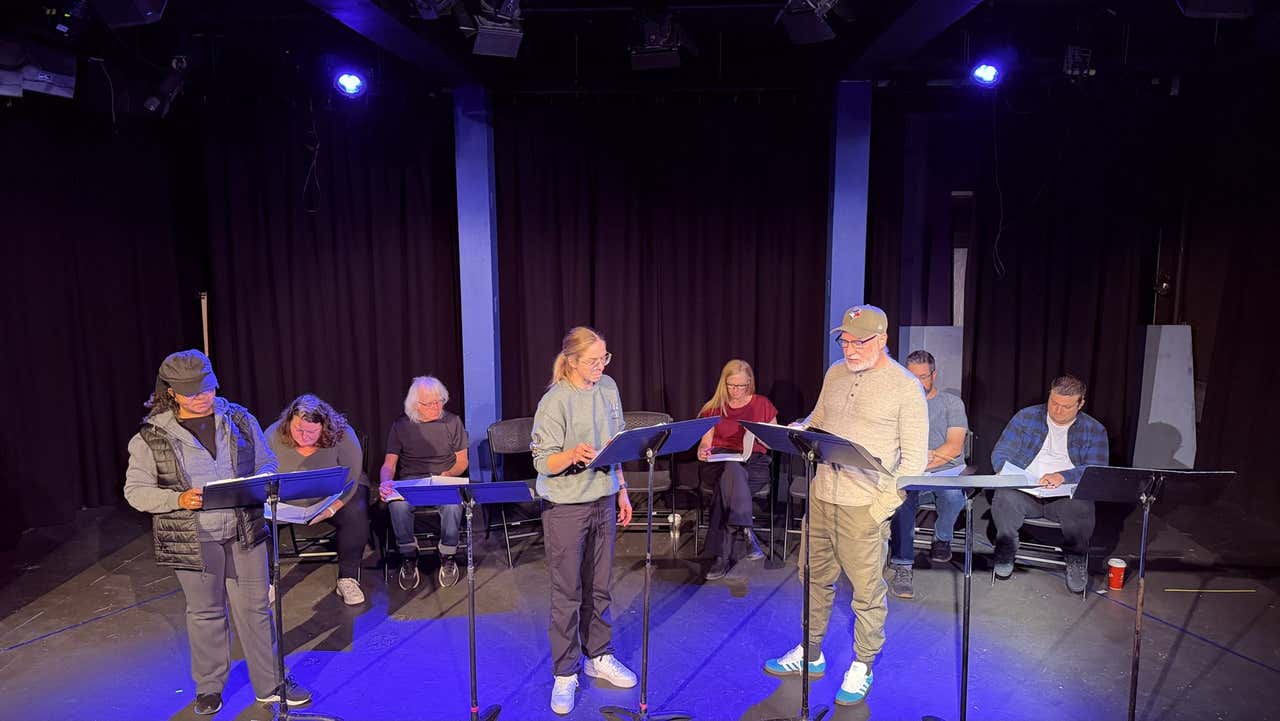
Last night we read A Streetcar Named Desire at the Firehall to a sold-out house. I'm still buzzing. From where I sat, the audience was with these actors the whole way through, hanging on every word, with nothing on stage but music stands and Tennessee Williams.
In the weeks before the reading, I sent our four leads a handful of questions about the characters they were taking on. The plan was to share their answers ahead of the show, but they never quite made it out the door. Reading them back this morning, they feel like a record of how the performances we saw last night were built, so here they are, in the actors' own words.
If you read my last post, you'll remember I interviewed myself about directing this one. These are the people who actually had to stand at the music stands and do it.
Lisa Heitzner as Blanche DuBois
You saw Lisa light up the stage as Donna in Mamma Mia. Then she took on one of the most demanding roles ever written.
Q: Blanche is one of the most demanding roles ever written. What scared you most about saying yes?
A: My biggest fear was definitely the sheer emotional stamina Blanche requires. So many iconic actresses have given unforgettable performances in this role, and it carries such legacy. I wanted to be certain I could do her justice, capturing her fierce survival instinct alongside her delicate fragility. Williams wrote her so brilliantly, and my priority from day one has been to honor that balance.
Q: You went from Donna, warm and belting ABBA, to Blanche, who's fragile and unravelling. How do you make that switch?
A: It really is a complete shift in energy. Donna stands in the full sunlight and wears her heart on her sleeve. Blanche lives in the shadows, constantly shielding herself behind romance and illusions. I had to move from Donna's raw, physical instinct to Blanche's internal, guarded world.
Q: In a musical, a song can carry you through a big emotion. In a reading, there's nothing but the words. Is that more frightening or more freeing?
A: Challenging is more the word I would use. Without music, you are completely reliant on the text. But Tennessee Williams wrote Blanche with her own internal music. She speaks in poetic crescendos and quiet minor keys depending on who she's manipulating or seeking comfort from. Once I unlocked that cadence in rehearsal, the words themselves became the score.
Q: What did playing Donna teach you that you're bringing to Blanche?
A: Never to judge a character's choices, but to understand her survival instincts. Both women carry deeply buried heartbreak. Donna channeled hers into building a life; Blanche channeled hers into fantasy. Behind every dramatic exterior is a woman just trying to hold her world together.
Q: Where's the line between Blanche's performance of herself and her real breaking?
A: The line blurs when her performance is no longer a choice, but her only means of survival. She uses charm, etiquette, and fantasy to force the world to see her as soft and untarnished. The real break happens when the weight of reality becomes too heavy for her illusions to hold. Facing the truth of her trauma would mean admitting that she has lost everything: her home, her youth, her dignity, and her safety. When she can no longer separate the fantasy from reality, that's where she shatters.
Q: Is there a moment in the play you dread, and one you can't wait for?
A: I always brace myself for the tragic final scene. Saying goodbye to Stella and handing her fate over to strangers is heartbreaking to play. But I look forward to her quieter, softer scenes with Mitch. There's a delicate tenderness there where you see a glimmer of hope for her, before everything slips away.
Q: What do you want people to feel for her that they might not expect to?
A: I hope people walk away feeling deep compassion for her. On the surface, Blanche can easily be dismissed as dramatic, difficult, or manipulative. But beneath all the grandstanding, she is a deeply traumatized survivor who is desperate for safety and kindness. We are often so quick to judge people's outer behavior without knowing the burdens they carry. If the audience can feel empathy for Blanche, maybe they'll extend a little more grace to the complex people in their own lives.

Working a scene at the music stands.
Craig Martin as Stanley Kowalski
You laughed with him as Bill in Mamma Mia. Then Craig stepped into one of the most volatile men in American theatre.
Q: From a likeable dad in Mamma Mia to Stanley. What's that like?
A: Stepping into Stanley's shoes has been a pleasure and a challenge. I have a lot more in common with a character like Bill than I do with Stanley. I personally tend to distance myself from conflict, where Stanley throws himself right into it. I thoroughly enjoy a challenge, however.
Q: Stanley's become shorthand for a certain kind of man. How do you play him as a person, not a symbol?
A: I try to play everything as authentically as possible. Stanley is definitely a symbol of toxic masculinity, but if he is played as just that, some of the nuance is lost. Tennessee Williams's incredible writing includes everything needed to make him a real person.
Q: Does comedy timing help you find his charm, not just his menace?
A: He is a simple man who is easily annoyed and has no patience. This can come across as funny when dealing with his male friends, but not so much when dealing with his wife and sister-in-law. Playing more comedic characters in the past helps to make him more rounded and find some humour in him.
Q: How do you keep that intensity honest in a reading, without the physical staging to hide behind?
A: This has probably been the most challenging thing for me. Stanley is a very physical man, and it is difficult to portray his animal physicality when just reading. Hopefully I can bring some of this through just the words.
Q: What do you think people get wrong about Stanley?
A: I think people might look past the fact that he is most likely dealing with PTSD after serving as an engineer in WW2. Taking this out on his wife and sister-in-law is of course not acceptable, but it is one thing I think about in order to play him as a real person.
Gloria Digby as Stella Kowalski
Stella stands between her sister and her husband, and the whole play pulls at her from both sides.
Q: Stella's caught between the two biggest forces in the play. How do you make her choices feel real rather than weak?
A: Stella is caught between her sister and her husband. She finds familiarity and comfort with both, while being a support system to them as well. Her choices come from a lens of survival, not weakness. She's making compromises because, in the moment, they feel like the safest or most manageable choice for her.
Q: What's going on underneath her that the audience might miss?
A: Stella is feeling a lot of fear and guilt throughout the whole show. Though she often normalizes scenarios or pretends that things are fine, there is so much more happening inside than what she lets the world see.
Q: Which scene asks the most of you?
A: The final scene of the play is one that has brought tears to my eyes throughout the reading process. It really shows Stella's struggle of being caught between two worlds. There is a big weight on her, as any decision she makes in that moment is not going to make her truly happy.

Rehearsal at the Firehall Theatre.
Jonathan Crilly as Mitch
In a play full of brutal people, Mitch is the one who seems kind. I asked Jonathan what it's like to play a decent man who doesn't stay decent.
Q: Mitch is the tender one in a brutal world. What draws you to him?
A: Mitch is a relatable character. He cares deeply for his family, and is willing to be vulnerable in his search for someone to share life with. At the same time, he is a flawed man who, when pushed, shows that he too has a capacity for cruelty. It is interesting to see Mitch struggle to stay the man he wants to be and who he turns into when he feels slighted and humiliated.
Q: How do you play his hope, knowing where it ends up?
A: I think it'd be easy to play Mitch as naive or gullible. But I see him as more earnest in his hope for a life with Blanche. To play it any way other than giving himself 100% to the idea of a chance of happiness with her would make his shift to anger and cruelty unbelievable.
Q: What's the trickiest shift for him across the play?
A: Making that shift from hope and tenderness to angry and cruel. All he wants in life is someone to come home to, but he lets his humiliation and feeling of betrayal drive his responses.
Q: What surprised you about the role?
A: How unfortunately real he is. You want him to be the "good guy," to live up to his potential and protect Blanche. But along with the tenderness and vulnerability he's capable of, there's an insecurity and pride that prevents him from realizing his desires.
Reading these back, what strikes me is how none of them were willing to let their character off easy, or write them off either. Blanche isn't just a fragile mess, Stanley isn't just a brute, Stella isn't just weak, and Mitch isn't just the nice guy. That's Tennessee Williams for you, and it's exactly what these four went looking for. You could feel it in the room last night.
So... what's next?
In my first post about this reading, I said I hoped for three things: that folks would come out to see it, that there'd be a real excitement around the script and what our actors could do with it, and an urgency to see it fully staged. I'd say we got the first two.
The third is the open question. Whether to take a reading to a full production is always a big decision, but I think Streetcar could really work in the Firehall. It's a small room, and this is a play about people crammed into a tiny apartment with no way to get away from each other. It's something I'm seriously considering.
So I'm putting it out there. If you were in the audience last night, or you wish you had been, would you come see Streetcar fully staged at the Firehall? Let me know, or tell the Northumberland Players directly. That's the kind of thing that makes the case.
Thank you to Lisa, Craig, Gloria and Jonathan, and to the rest of the cast: April Corning, Ian Eddy, Ernie Anderson and Doug Knight. Thank you to Val Russell for producing. And thank you to everyone who filled the seats last night.