The Padre and the Doctor Who Stayed
I was singing Requiem for a Soldier at St. Andrew's United in Westwood last weekend when the minister told the story of Padre John Weir Foote, who had every chance to leave the beach at Dieppe, and chose to STAY with the wounded. My mom filled me in on the doctor who stayed with him.
I was singing Requiem for a Soldier at St. Andrew's United Church in Westwood last weekend, and the minister talked about a man from the area, John Weir Foote. Westwood and Norwood are a two-church parish, and Foote was a member at Norwood United, so that's why it was relevant to talk about him. I had never heard of him. I should have!
As part of the service, she also read off all the names of the people from the congregation who had died in service. This is a little rural church! I was amazed at how many brothers and fathers of the same family had died.
Foote was born in Madoc in 1904, became a Presbyterian minister in the 1930s, and had a congregation in Port Hope when the war started. He joined up as a chaplain, a padre, and ended up with the Royal Hamilton Light Infantry. Now, a padre is a non-combatant. No rifle, no weapon, NOTHING, he's there to look after the men.

Padre John Weir Foote, VC. Photo: Wikipedia
On August 19, 1942, the RHLI landed at Dieppe. If you don't know how that went (I'll be honest, I only knew the outline), it was a disaster, and the Canadians took the worst of it.

The beach at Dieppe, August 1942. Photo: Bundesarchiv, Bild 101I-291-1229-17A / Meyer; Wiltberger / CC BY-SA 3.0 DE, via Wikimedia Commons

The regimental aid post on the beach was a little dip in the sand that only gave you cover if you were lying flat. The doctor running it was the RHLI's medical officer, Captain David Wesley Clare, who was 27 years old.
Now, the minister didn't mention Clare at all. My mom filled me in on him afterwards. He happened to be a close relative of her university roommate from Kingsville, Ontario, and there was lots of memorabilia and other artifacts from his service years in their home. Small world!
For about eight hours Foote kept leaving the cover of that aid post, going out onto the open beach under fire to give first aid and morphine, and carrying wounded men back. When the tide went out they moved the aid post behind a stranded landing craft, and when shells set the ammunition inside it on fire, he went in and got the wounded out. When the boats finally came, he carried men through the fire to get them on board.
Clare, meanwhile, ran out of medical supplies almost right away (there were just too many casualties) and had to improvise with whatever he could find.
Foote saved a ton of folks that day, and somehow, miraculously, he didn't get hit.
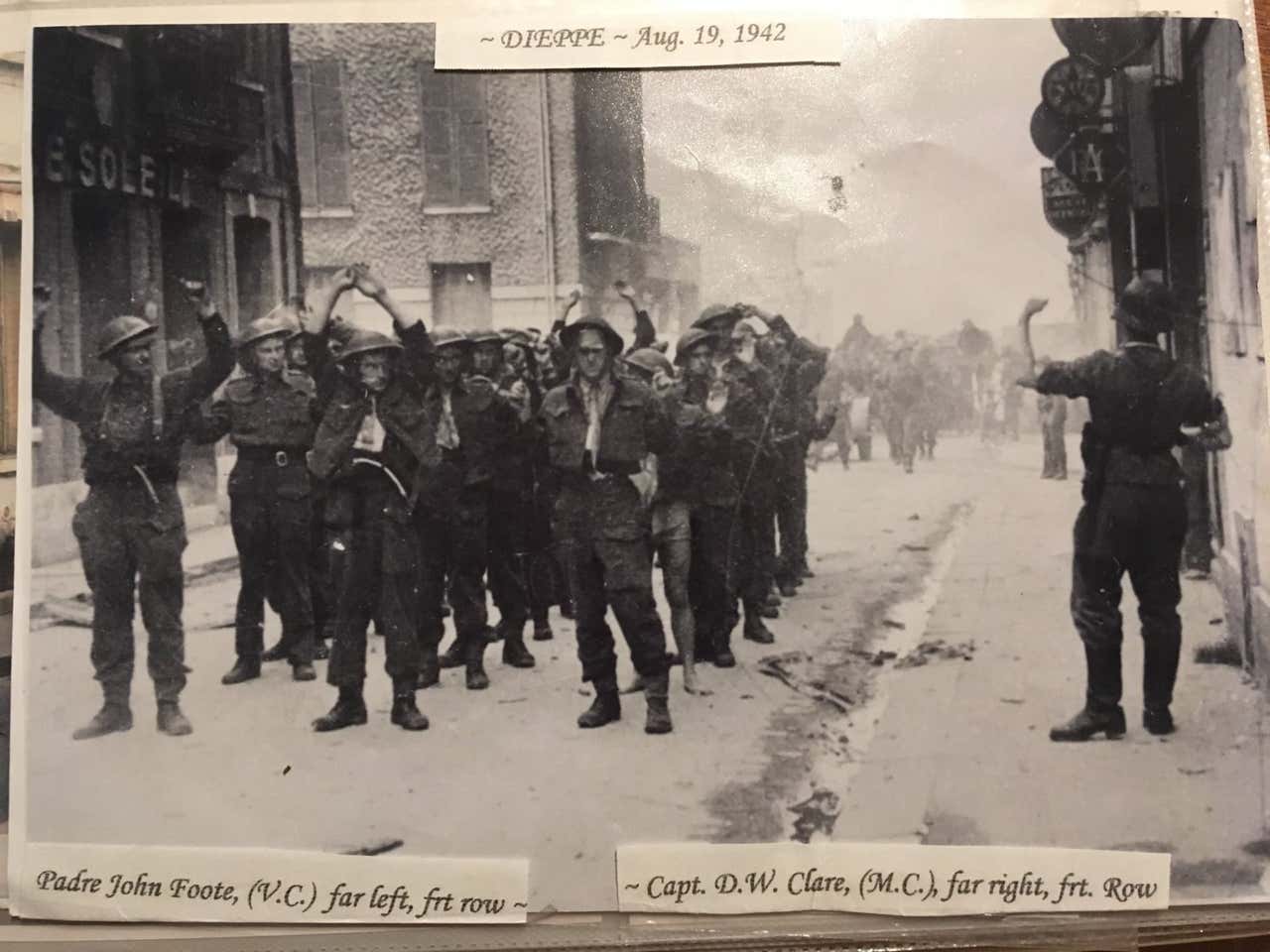
Back to the part the minister talked about, which is the part I can't stop thinking about. Foote had chances to get on a boat and go home. More than once! He kept going back to the beach. And at the very end he turned down his last chance, and chose to STAY with the wounded who couldn't make it to safety. Clare did the same thing, he refused a spot on the last landing craft because he believed he was the only doctor left on that part of the beach, and the men still lying there needed him if they were going to live.
So they were both captured, and they spent almost three years as prisoners of war. Clare ended up at Stalag VIIIB at Lamsdorf, kept doctoring the whole time, and kept a diary through the forced march at the end of the war, right up until British troops liberated him on Easter Monday, 1945.
Foote was awarded the Victoria Cross in 1946, the only Canadian chaplain who has ever received one. Clare got the Military Cross. Foote apparently always said it was an ordinary thing to do, he was just doing his job. Which, I mean, technically yes, but come on.
He came home to this area, too. He was the MPP for Durham from 1948 to 1959, lived in Cobourg for the rest of his life, and the Legion branch in Grafton is named after him. The armoury in Hamilton where the RHLI is based is named after him as well, and that's where his medals are.

The John Weir Foote VC Armoury in Hamilton. Photo: Wikimedia Commons

This story made me think about true bravery and integrity. It's one thing to have a belief - in God, in moral values, all those things - but it's something else entirely to not only risk one's life for it, but to do so repeatedly… we can learn from that.
Header photo: Padre John Foote (far left, front row) and Capt. D.W. Clare (far right, front row) after their capture at Dieppe, August 19, 1942. Photo: Prisoners of War Museum